

How to Apply
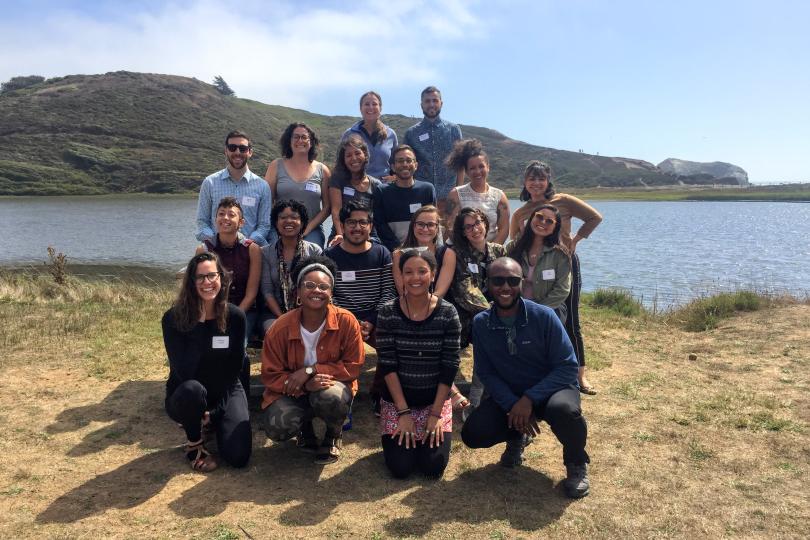
Switzer Fellows at the 2019 Fall Retreat
Applications for 2027 Switzer Fellowships are now open (link below). Applications are due at 11:59 pm PST on Monday, December 14, 2026.
Applicants must read the eligibility requirements and application guidelines on the Become a Fellow page carefully before applying. Successful applications take a lot of time and work, and incomplete applications will not be reviewed.
Black, Indigenous and students of color, first-generation college students, and individuals from groups traditionally underrepresented in environmental graduate programs are strongly encouraged to apply. Visit the application guidelines and FAQ to learn more.
If you have a question not answered in the FAQ, please see staff contact information at the bottom of this page.
All applicants must submit an online application form, found at the bottom of this page. The application form enables applicants to save their work, make edits and track progress during the review process. Specific application instructions are provided on the application form. The general guidance below is intended to help you prepare the necessary documentation. Please review the evaluation criteria and application guidelines for more detail.
It can be helpful to talk with a Switzer Fellow alum for perspective about the application process. Applicants may look in the Fellow Directory to find fellowship alumni from your school, or submit a request (by November 16th) for help connecting with a past fellow. Watch an upcoming or recorded information session with staff and recent fellows to gain valuable perspective.
APPLICATIONS WILL NOT BE CONSIDERED COMPLETE UNLESS ALL OF THE REQUIRED MATERIALS ARE SUBMITTED ON TIME AS INSTRUCTED. We cannot allow any exceptions.
The following materials are required:
- Three short-answer narrative questions. Each response is limited to 1000 characters. These questions ask: 1) “Why are the environmental challenges you work on personally important to you and what practical solutions do you hope to contribute?” 2) “Please provide an example of how you have engaged people and/or communities affected by the issues addressed by your environmental work.” 3) “Beyond the fellowship year, what do you hope to learn from the Switzer Network and what do you hope to contribute to the network?”
- A 2 page original essay. The essay question is: “What does leadership mean to you? How have you shown up as a leader in the past and what do you envision for your future as an environmental leader?” The essay field is limited to 7,000 characters (approximately two pages, single spaced, in 12-point font.)
- The written essay and short answer questions are the best way for us to get a sense of who you are, your leadership style, and your commitment to positive environmental and social change. They are opportunities for you to reflect on your leadership skills and potential, how you plan to apply your skills and studies to your career, and how you will advance equity as a fundamental part of your environmental problem-solving. You may describe your academic work and how it furthers your goals, but academics should not be the sole focus of the essay. Share specific examples of how you have been and hope to be a leader and contribute to advancing environmental and social change, including any personal and professional challenges you have overcome to achieve your goals. We welcome a range of communication and leadership styles. Communicating your personal story, unique leadership skills and potential, and commitment to applied environmental and social change is more important than polished writing skills.
- Two professional letters of recommendation. Recommendation letters must be submitted by your recommender directly to the foundation per the Recommendation Instructions. At the time of your application, you will be asked to provide contact information for two recommenders. Letters of recommendation are also due by 11:59 pm PST December 14, 2026. Letters can be from your academic advisors or close colleagues who know you and your work well, as we ask recommenders to relay specific information and examples of your work. It is helpful for one of the two letters to be from your academic advisor, a committee member, or academic colleague, especially for Ph.D. applicants. Your second recommender can be anyone familiar with your professional or volunteer experience, leadership roles, or other accomplishments. (Please refer to the Frequently Asked Questions for guidance on choosing your recommenders.) Only two letters of recommendation may be submitted. You are responsible for ensuring that your recommenders send their letters by the deadline, and that they carefully review the recommendation instructions to ensure they are giving us the information we need. Recommendation letters must be uploaded in Adobe PDF format.
- Highlights from your resume. Your resume is an important part of your application. You will be asked to include a list of your five most important and relevant academic experiences, work or volunteer experiences, and honors, fellowships, and awards. Please do not include information about your publications or presentations.
- Most recent graduate academic transcripts. A transcript of your graduate study is required (an unofficial version is acceptable if official transcripts cannot be obtained by the application deadline). Transcripts must be uploaded in Adobe PDF or JPEG format. Undergraduate transcripts are not necessary except in the case of applicants enrolling in one-year master's programs with no other graduate school experience. Specific instructions can be found on the application form.
Contacts for further information:
For eligibility and general questions or technical assistance, contact Laine Kuehn (they/them), Administrative Coordinator.