

McClintock explores networked governance of Montreal’s solidarity greenhouses
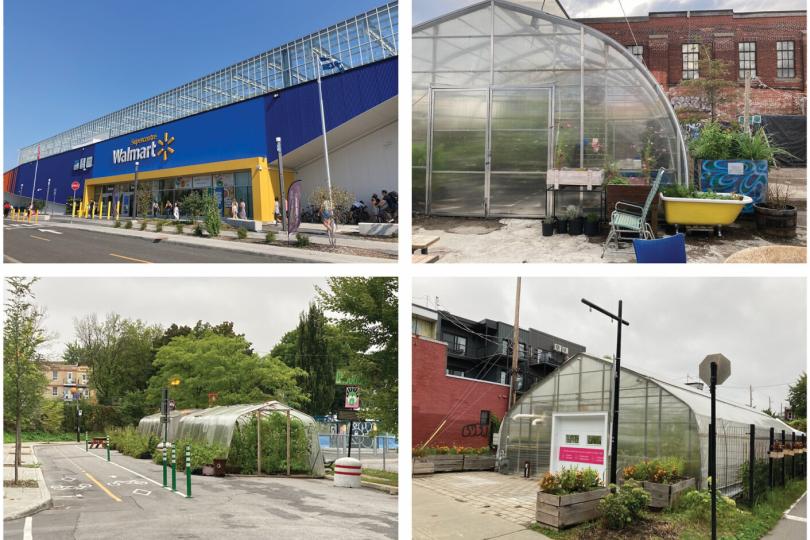
Four Montreal greenhouses. (a) Lufa Farms (commercial), Ahuntisc, September 2024. (b) Fermette B7 (solidarity), Pointe-Saint-Charles, September 2023. (c) Emily-De-Witt (solidarity), Centre-Sud, September 2022. (d) Serres de rue (solidarity), Centre-Sud, September 2022. Photos by Nathan McClintock.
Content below adapted from the article abstract.
Greenhouses are becoming a regular feature of the urban landscape, their popularity driven in part by an eco-futurist, techno-optimist vision of “vertical farming” that articulates with entrepreneurial green urbanism. In Montreal (Quebec, Canada), however, urban greenhouses tend to be small-scale, low-tech infrastructures operated by networks of state, non-profit, and community actors, with an equity-oriented mission of working in solidarity with–and providing material support for–marginalized populations.
In this article, Nathan McClintock and co-authors characterize the everyday governance of these “solidarity greenhouses” (serres solidaires) and examine the conditions that mediate their emergence and success within twin contexts of austerity and entrepreneurial urbanism. Examining three key challenge areas–project definition, municipal regulations, and funding–and how project leaders navigate them, we reveal how everyday governance is a function of relational and differential power between partners and the ability to navigate a shifting funding landscape. Governance is further deeply influenced by Quebec’s unique “community action” model and the ongoing dismantling of a once-robust welfare state.
Read the full open-access article here.
Citation:
McClintock, N., Van Neste, S. L., Gailloux, C., Barnabé, F., & Flory-Célini, C. (2025). Between state–community partnerships and austerity: The everyday networked governance of Montreal’s solidarity greenhouses. Urban Studies, 0(0). https://doi.org/10.1177/00420980251398620