

Lupe Franco: how are municipalities in California tackling climate change and homelessness?
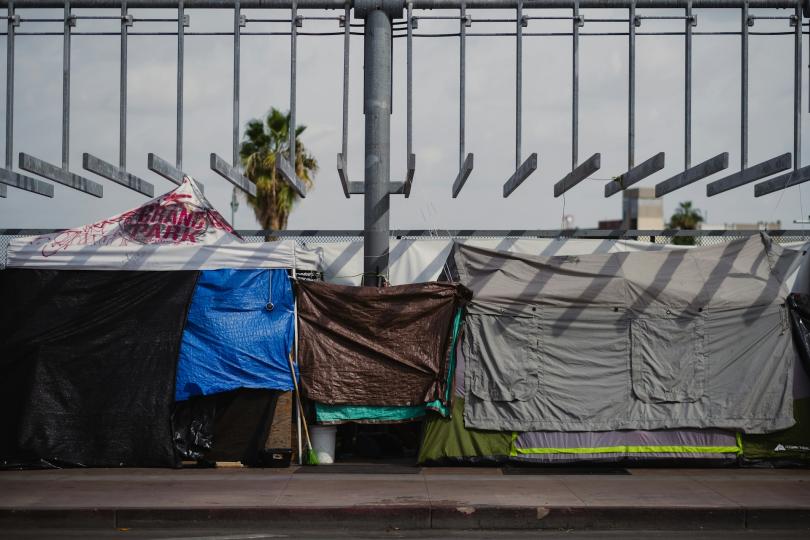
An unhoused encampment in downtown Los Angeles. Photo: Levi Meir Clancy / Unsplash.
Lupe Franco recently published her first solo-authored paper, Wicked Problems: How Are Municipalities in California Tackling Climate Change and Homelessness?, in the International Journal of Urban Sustainable Development.
“This work is the culmination of my master's program at San José State University, where I analyzed climate action plans across California's jurisdictions to understand how, if at all, unhoused populations were being considered in climate planning,” she posted on LinkedIn.
“One of the most glaring gaps is the near-total absence of strategies that address the needs of unhoused populations – leaving them largely invisible in broader climate discussions. The research offers recommendations for municipalities to include people who live and sleep outside in climate action plans, so they are part of the solution in building more just and resilient communities. Specifically, I recommend ways to increase equity in climate planning, support unhoused populations in coping with climate change, and strengthen community engagement.”
Check out the abstract and key findings below, and read the full open-access article here.
Abstract
California is facing two wicked problems: climate change and homelessness. The state is experiencing many detrimental effects of climate change, including poor air quality, flooding, heat waves, and increasingly destructive wildfires. Concurrently, the state has seen an increase in the number of unhoused individuals due to skyrocketing housing values, failed political leadership, limited health and social services, growing income inequality, and restrictive housing policies. While unhoused populations struggle to access basic services, they must also face the impacts of climate change as they live and often sleep outside. As California’s cities and counties begin to address climate change by developing climate action plans, it is important to assess how, and to what extent, these plans consider the unhoused, who are arguably California’s most climate-vulnerable community. This study analyzes 15 climate action plans and 14 semi-structured interviews with government officials representing 11 jurisdictions across Southern California and the San Francisco Bay Area. This research reveals that unhoused communities have been largely left out of climate decision-making processes and offers recommendations for municipalities to include people who live and sleep outside in climate action plans, so they are part of the solution to build more just and resilient communities.
Highlights
- Climate planning must emphasize social and environmental justice, including the issues of affordable housing and unhoused populations
- It is crucial for local government to build community engagement efforts among unhoused communities and their service providers
- Cities must develop climate strategies that help unhoused populations cope with climate change while pushing for more public housing
Franco, G. M. (2026). Wicked problems: how are municipalities in California tackling climate change and homelessness? International Journal of Urban Sustainable Development, 18(1), 239–257. https://doi.org/10.1080/19463138.2026.2684819